Skydiving Guides
|
8 min read
Bali Skydiving Proposal: 3 Safe Ways to Pop the Question from Up to 14,000 Feet
18 Sep 2026
Read

 Sky Dive in Bali Editorial Desk
AFF skydiving is not yet available in Bali: no outdoor drop zone operates on the island as of 2026, and Sky Dive Bali has not announced an Accelerated Freefall course or licensing pathway. The realistic 2027 plan for guests who want more than one jump is wind-tunnel coaching at iFly Bali now, paired later with a licensed AFF school elsewhere in Asia.
AFF stands for Accelerated Freefall, the training method most solo skydivers use on the way to a license. A tandem jump harnesses you to an instructor for one freefall of roughly 60 seconds. AFF is different: it puts a student under their own canopy from the first supervised jump onward, building toward independent flight.
Guests who enjoyed a first tandem and then search “AFF skydiving Bali 2027” are usually asking one thing — can the next step happen here on the island, or does it require travel? As of September 2026, the honest answer is travel. Bali has a growing tandem waiting-list market, but no operating outdoor drop zone and no published AFF curriculum tied to any Bali brand, including Sky Dive Bali.
Federations built around the USPA model, the international reference point most schools across Asia follow, structure the journey in four stages, each with its own entry requirements. The table below lays out what each stage typically demands before a student moves on.
| Stage | What Happens | Typical Prerequisites |
|---|---|---|
| Tandem jump | One freefall (about 60 seconds) harnessed to an instructor | Age 18+ at most operators; guest weight within dropzone limits |
| Indoor wind-tunnel coaching | Coached body-flight sessions in a vertical tunnel | No prior experience needed; minimum age varies by facility |
| AFF course | Roughly 7-8 instructor-supervised jumps plus 4-8 hours of ground school | Age 18+ (or 16 with consent at some federations); baseline fitness; no license required to start |
| Coach / consolidation jumps | Roughly 10-18 further supervised solo jumps | AFF course completed |
| A-license exams | Written, oral and practical exams plus a canopy-packing check | Minimum 25 total jumps logged |
Two details matter for anyone mapping this out. First, AFF is not one jump — it is a course of seven to eight instructor-supervised jumps preceded by several hours of ground school. Second, finishing AFF does not hand over a license on its own; a further block of coach-supervised jumps, typically ten to eighteen, comes before the written, oral and practical exams that lead to an A-license.
One rung of the ladder already exists on the island: indoor wind-tunnel time. iFly Bali, a vertical wind tunnel inside Trans Studio Mall Bali in Denpasar, runs year-round and accepts flyers from age three. A tunnel session will not replace an outdoor AFF jump, but body-flight coaches commonly treat tunnel hours as useful preparation for the stable arch and turn control that the first AFF levels test on a live jump.
For anyone currently on the Sky Dive Bali waiting list, that means the wait does not have to be idle. Booking iFly Bali sessions between now and whenever the tandem service opens is a practical way to get comfortable with freefall body position before a first outdoor jump ever happens.
There is no operating outdoor tandem drop zone anywhere in Indonesia as of 2026, and the country has never had a permanent one. That gap is the reason Sky Dive Bali itself is a waiting-list desk rather than a booking page: the tandem service is coming soon, with no confirmed opening date, and the only current action available to guests is registering an email through the homepage form, tracked on the 2027 opening status page.
An AFF course sits a further step beyond even a tandem operation. Running one requires a licensed, operating drop zone, AFF-rated instructors, aircraft or equivalent jump-lift capacity, and sign-off from Indonesia’s aviation and aero-sport regulators — none of which Sky Dive Bali has announced. Third-party pages describe a planned west-coast zone near Kelating in Tabanan; treat that as operator marketing rather than a confirmed, licensed facility until it is independently verified as open.
Until a Bali-based AFF program is licensed and operating, the nearest operating tandem and AFF drop zones sit in Thailand, currently the closest active facilities to Indonesia for guests who want to continue past a single tandem jump. Planning an AFF course for 2027 realistically means budgeting for a short regional trip to a licensed school rather than a domestic booking.
Season matters for any outdoor jump, tandem or AFF. Bali’s dry season runs roughly April through October, and 2026 guides for the region point to May through September as the strongest window, with sunnier days, steadier winds and better visibility for spotting the coastline from altitude. The wet season, November through March, brings afternoon storms and a lower cloud base that can ground outdoor jumps with little warning. Nyepi, the Day of Silence, falls in March each year and closes the island and its airport for 24 hours, so anyone building a 2027 trip around a Bali tandem or a regional AFF course should confirm the exact 2027 date before locking in flights.
Guests planning a longer 2027 trip that also touches Sky Dive Bali (Juara Holding Group)’s Labuan Bajo yacht charters or Sky Dive Bali (Juara Holding Group)’s villas can ask the waiting-list desk about combining bookings across Juara Holding Group’s sister brands, though no combined-booking terms have been published yet.
Because the pieces of this journey sit in different places on different timelines, it helps to separate what can be booked today from what still depends on announcements to come.
| When | What You Can Do | Where |
|---|---|---|
| Now (2026) | Join the Sky Dive Bali waiting list; book iFly Bali tunnel sessions | Tandem: waiting list only. Tunnel: open now, Trans Studio Mall Denpasar |
| Now through 2027 | Research licensed AFF schools for a short regional trip | Nearest operating drop zones: Thailand |
| When Sky Dive Bali opens | Book the tandem jump with locked-in waiting-list pricing | Skydive Buleleng drop zone, North Bali, per the Sky Dive Bali site |
| Beyond the tandem | Any AFF or license course would need a separate, licensed provider | Outside Bali until an AFF program is announced and licensed |
Every row past the first depends on an announcement Sky Dive Bali has not made. Joining the waiting list now secures priority slot allocation and the pricing in place at the time of the desk’s 2026 planning, but it does not reserve a place in an AFF course, because no such course exists yet.
Any future AFF program in Indonesia would need clearance from the Directorate General of Civil Aviation under the Ministry of Transportation, plus recognition from FASI, Indonesia’s aero-sport federation, which oversees parachuting and related air sports domestically. USPA remains the international reference point most instructors and training curricula point to, even for programs based outside the United States. The Bali Provincial Tourism Office tracks tourism-adjacent activities like this one as well, though it does not license the jump training itself.
No. As of 2026, no AFF course, outdoor drop zone, or skydiving license program operates in Bali or anywhere in Indonesia. Sky Dive Bali’s own service is a tandem-only waiting list, coming soon with no confirmed opening date, and it has not announced any AFF or licensing pathway.
Yes, informally. iFly Bali’s vertical wind tunnel at Trans Studio Mall in Denpasar runs year-round and welcomes flyers from age three. Tunnel time builds the stable body position and turn control that early AFF jumps test, though it does not substitute for outdoor freefall jumps or count toward a license.
Under a standard USPA-style path, expect roughly seven to eight AFF jumps after ground school, then another ten to eighteen coach-supervised jumps, reaching a minimum of twenty-five total logged jumps before the written, oral and practical exams for an A-license.

Sky Dive in Bali Editorial Desk
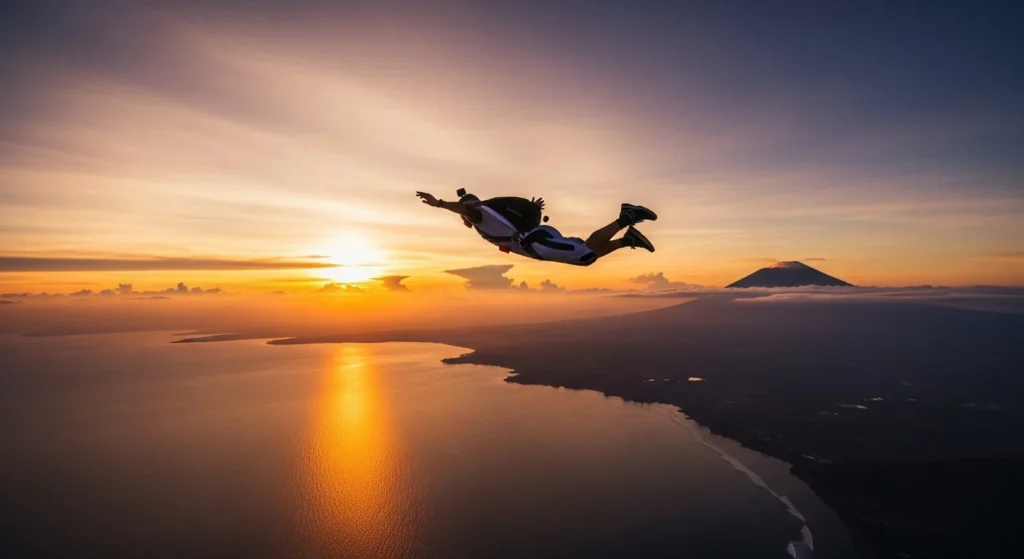
Experience the thrill of skydiving in Bali with our certified instructors. Book your tandem jump today.