
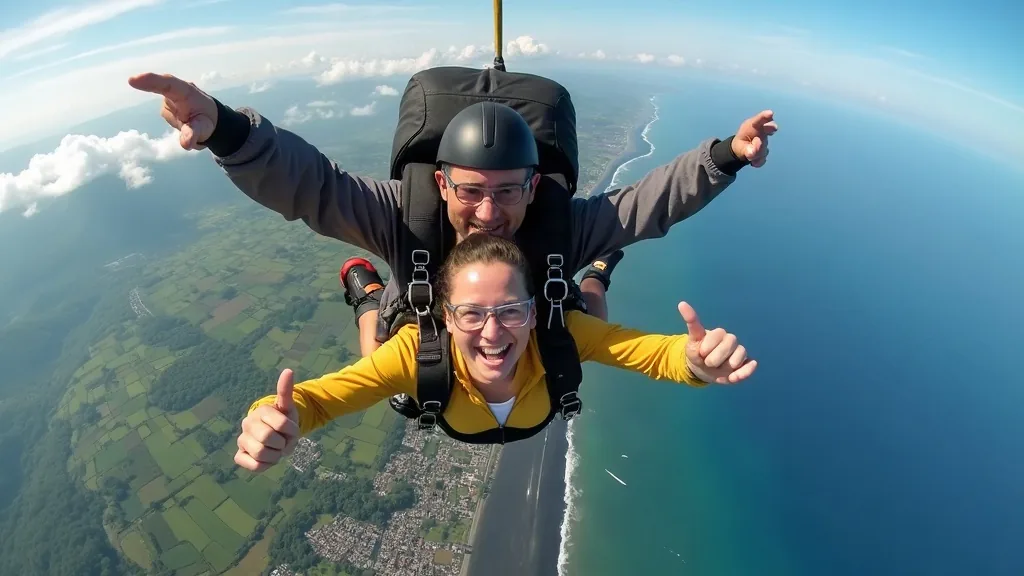
5 million as of August 2026). Investors can participate in infrastructure, aircraft, training, ESG, and marketing phases before public launch.
How strong is the market outlook for skydiving in Bali over the next 5–10 years?
Bali receives millions of international visitors annually, and premium adventure products, including those priced at USD 1,200 per guest, are well established in diving, yacht charters, and private tours. Sky Dive Bali has aligned its tandem price at USD 1,200 (about Rp 19.5 million as of August 2026), targeting the same high-yield segment while keeping volume intentionally moderate.
the North Bali drop zone are ready: the main Tabanan Bali skydiving drop zone at the Buleleng coast, around 1.5 hours by road from Seminyak/Canggu, and a Buleleng Bali skydiving drop zone in North Bali with views toward Mount Batur.
This creates a window in which capital can be deployed before the first commercial tandem guests arrive. Demand signals already exist through pre-registration forms, social media interest, and media inquiries for Bali skydiving press trip opportunities, especially for content around Bali skydiving near Kuta and Canggu. The project also intersects with longer-stay segments, including those exploring Bali skydiving for digital nomads and long stay visitors 2027, providing a base of repeat users and referral traffic once operations go live.
What regulatory and ATC coordination steps shape risk and upside for investors?
Sky Dive Bali has publicly stated that it will not begin paid public operations until these stakeholders reach fully operational status for the drop zones.
For investors, this means near-term returns depend on the timetable for Bali skydiving ATC coordination procedures and sport aviation licensing, but it also means the project is intentionally structured on a compliance-first basis. Capital can be focused on infrastructure, safety systems, training, and environmental assessment for Bali drop zone locations during this pre-revenue phase.
Once approvals are finalized, an operator that already has documented procedures for Bali skydiving parachute inspection, crew training, and medical/weight limits (for example, a 100 kg maximum passenger weight and minimum age of 18, or 16 with parental consent, as released for 2026) is positioned to ramp up quickly. This approach can provide a defensible entry barrier, as new entrants must repeat similar multi-agency coordination before flying revenue loads.
What physical assets and on-ground experiences can investors help build around each drop zone?
The Tabanan Bali skydiving drop zone at the Buleleng coast offers coastal access and road connectivity from major tourism hubs, making it suitable for a more “beach day plus skydive” product. Ancillary businesses can include a Bali skydiving coffee shop near drop zone operations, simple pre-jump lounges, and photo/video editing suites. North Bali’s Buleleng site has cooler temperatures and mountain views, more suitable for all-day programs integrating waterfalls, coffee plantations, and cultural tours.
Investors can stake early claims in F&B, retail, or co-located services. For instance, demand for halal food near Bali skydiving drop zone areas is expected from Indonesian, Malaysian, and Middle Eastern visitors who already travel to Bali in growing numbers. Simple additions such as prayer rooms, modest changing facilities, and multilingual menus can significantly broaden the addressable market at relatively low capex.
Beyond F&B, there is scope for boutique accommodations, co-working pods, and outdoor lounges to help position some parts of the project to cross-promote with higher-value itineraries such as Bali skydiving packages 2027 with surfing and freediving on the south and east coasts. This type of joint packaging can extend average length of stay and increase per-guest revenue, helping investors amortize fixed infrastructure over more experiences per visitor.
How does the Bali skydiving project integrate ESG and environmental considerations?
Adventure-air projects face increasing scrutiny on environmental and social impact. For Bali, environmental assessment for Bali drop zone sites must consider shoreline dynamics, village access, cultural sites, and noise footprint. Sky Dive Bali’s decision to hold off on commercial jumps until full coordination with civil and military authorities is complete aligns with an ESG-influenced approach that prioritizes safety and shared airspace planning.
ESG positioning can also be supported through local workforce development, such as training Balinese ground crew, manifest staff, and safety personnel. Partnering with local communities around the Buleleng coast and Buleleng to provide services—from transport to catering and photography—helps ensure revenues circulate locally and can reduce resistance to air operations.
On the environmental side, investors can help fund quieter aircraft choices, fuel-management practices, and visitor education around plastic reduction and respectful behavior at beach and village access points. Structuring Bali skydiving ESG positioning transparently can also help secure coverage in responsible travel media, adding to the value of future Bali skydiving press trip opportunities with journalists who focus on sustainable tourism narratives.
What guest segments and product designs offer the clearest revenue paths?
Bali attracts multiple segments willing to pay premium prices for high-memory experiences. At USD 1,200 per tandem (around Rp 19.5 million as of August 2026), tandem skydiving fits naturally alongside private yacht charters and advanced scuba training. Core guests are expected to be 25–55-year-old professionals, couples, and small groups seeking a “once in a lifetime” highlight.
There is also demand for specialized products. Some visitors ask about Bali skydiving for couples only experiences, with private aircraft loads, personalized video, and optional beachside celebration dinners. Others need guidance on Bali skydiving for people with back pain or previous surgery; a transparent pre-screening framework, coupled with medical waivers and clear exclusion criteria, can reduce risk while still converting suitable guests.
Seasonality matters. Bali skydiving in July benefits from peak holiday demand and great visibility, but ground congestion and accommodation prices are higher. Operational materials already reference May, June, and September as a “peak window” for sky conditions with lower crowd density than July–August. Investors can shape yield management strategies, pricing tiers, and marketing calendars to prioritize shoulder months where drop-zone throughput is smoother and variable costs are more predictable.
How do operations, safety standards, and logistics support commercial scalability?
Scaling any drop zone safely depends on systems. Bali skydiving parachute inspection regimes must follow manufacturer guidelines and local sport-aviation rules, with reserve repacks on a timed or jump-count basis and meticulous logbooks. Ground crew must enforce Bali skydiving footwear guidelines (closed shoes, no high heels, and secure lacing) to reduce aircraft and landing hazards.
The customer journey also benefits from clear processes: a Bali skydiving packing checklist for guests (ID, comfortable clothing, no scuba within 24 hours, no pregnancy, within stated weight and height limits) reduces on-site friction and refunds. For guests already in the south, operators can provide instructions on how to get to Bali skydiving drop zone locations in Tabanan and Buleleng, with shared transfers, private cars, or motorcycle options, and link those routes to popular centers for Bali skydiving near Kuta and Canggu.
From an investor’s perspective, standardized operations reduce key-person risk and support documentation for insurers and regulators. This also prepares the project for partnerships with international tour operators, wedding planners, and retreat organizers, especially those building programs that pair your jump with other experiences and longer stays oriented around Bali skydiving for digital nomads and long stay visitors 2027.
- Indicative tandem ticket pricing: USD 1,200 per person (approximately Rp 19.5 million as of August 2026), all-inclusive of gear, instruction, and standard media packages.
- Physical guest limits: minimum age 18 (16+ with parental consent), maximum passenger weight 100 kg, minimum height 140 cm, and no skydiving during pregnancy.
- Planned operational seasons: best weather windows in May, June, and September; high-demand but busier July–August; higher cancellation risk November–March.
- Ancillary on-site services: potential Bali skydiving coffee shop near drop zone, halal F&B options, gear rental, media editing, and transfers from southern resorts.
- Ownership and capital pathways: equity participation in infrastructure, aircraft sourcing, training programs, ancillary F&B, or bundled adventure itineraries.
Frequently asked questions
how to get to bali skydiving drop zone
Access to the the Buleleng coast drop zone in Tabanan is typically via private car or organized transfer, taking around 1.5 hours from Seminyak or Canggu. The Buleleng site in North Bali is reachable via the main northbound highways, usually 2.5–3.5 hours from the south. Shuttle services and bundled transport can be structured as investor-backed add-ons.
is skydiving bali investor opportunities worth it in Bali?
This leaves room to shape infrastructure, ESG frameworks, and product strategy before launch. Returns will depend on regulatory timelines, pricing discipline, and cross-selling with products such as Bali skydiving packages 2027 with surfing and freediving.
what is included in skydiving bali investor opportunities?
Typical investor participation can include equity or structured financing for aircraft, hangar and ground infrastructure, staff training, safety systems, F&B units, and supporting facilities. Some structures may also cover marketing cooperations, such as Bali skydiving press trip opportunities or packaging with bali skydiving near kuta and canggu experiences, subject to due diligence and negotiated terms.
Can guests with special conditions, like back pain, safely join Bali skydiving operations?
Sky Dive Bali communicates strict medical and physical guidelines, including weight, height, and exclusions for unstable heart conditions and pregnancy. Guests with back pain or prior surgery are usually asked for a recent medical letter. A clear screening system protects guests and investors by reducing incident risk and minimizing expensive last-minute cancellations on jump day.
How does seasonality, for example Bali skydiving in July, affect investor planning?
July in Bali is dry and popular, which usually supports strong booking demand but can also mean congested roads and higher staffing costs. Investor models should treat May, June, and September as weather-favorable growth months, with July–August as peak-volume, higher-cost periods. November–March should be modeled with conservative jump counts due to greater thunderstorm-related cancellations.
To explore structures, timelines, and site visits for Bali skydiving investor opportunities, contact the BD desk at Juara Holding Group (part of Juara Holding Group — since 2015) via our reservation form the Reserve My Spot form or email bd@juaraholding.com for a confidential discussion.
Last updated 1 August 2026