Drop Zones and Locations
|
2 min read
Best Tandem Skydive Location For Black Sand Beach Views Bali
03 Jul 2026
Read

 Sky Dive in Bali Editorial Desk
A Bali skydive beach landing follows the same core landing sequence used on any tandem jump: freefall ends near 60 seconds after exit, the canopy opens, you settle into a legs-up glide position, and your instructor steers a slide-in or stand-up touchdown timed to calmer morning air off the Bali Sea, with black-sand coastline visible on the final approach.
Bali’s north coast makes the descent distinctive. Volcanic-sand beaches, waterfalls inland, and open sea to the horizon frame the last minute in the air, but the mechanics of the landing itself work the same way they do at any well-run drop zone: canopy overhead, body position set, wind read, and a controlled glide to the ground.
Most of what makes a landing feel smooth or rough comes down to preparation before the plane door ever opens. Guests get a short ground briefing on legs-up position, harness handling, and what the instructor’s cues will sound and feel like in the air. Knowing that sequence ahead of time is what turns the last thirty seconds of a jump from a surprise into something you’re actually watching happen.
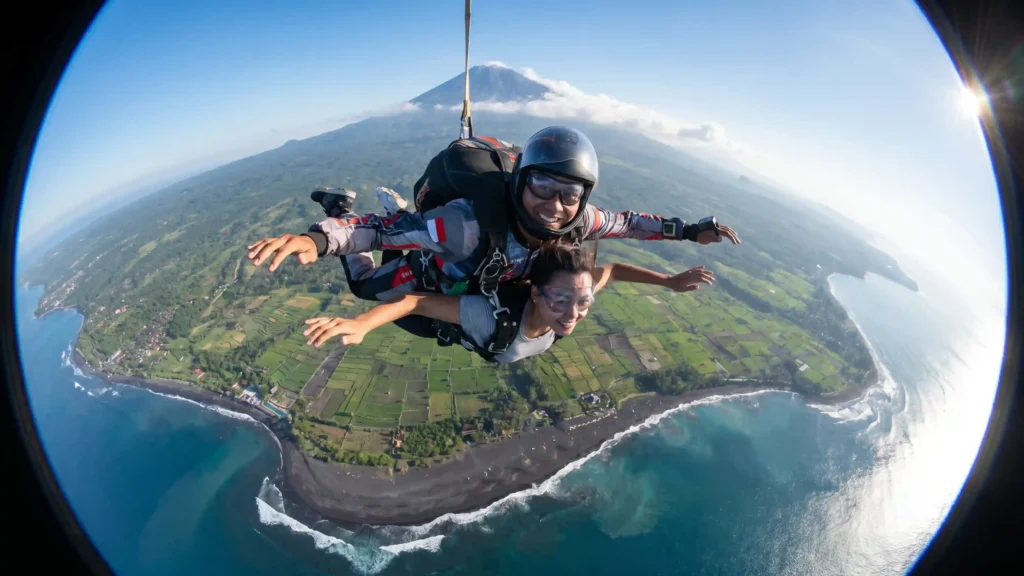
Freefall is the fast part, roughly 60 seconds from an exit near 10,000 feet before deployment. Everything changes the moment the canopy opens. The noise drops away, the fall slows into a controlled glide, and your instructor begins working the toggles to line up an approach.
This is also when instructors typically start talking guests through what comes next: how to position the body, where to look, and what signal means legs up. None of this requires skydiving experience. It requires listening and following two or three simple cues in the final seconds before touchdown.
Sky Dive Bali’s own drop-zone plan sits within its Buleleng location profile, the same black-sand-and-ridge terrain described on the North Bali skydiving drop zone page, though the operator confirms the exact landing field only once bookings open.
The standard tandem landing position is legs up, knees bent slightly, feet off the ground until the instructor’s feet make contact first. Guests are told to lift their legs into something close to a seated position, sometimes described as an invisible chair, and hold that position through the final few seconds of the glide.
Two things matter here more than anything else:
Guests who try to help by putting their feet down early are the most common cause of an awkward landing. The instructor is trained to manage the flare and touchdown; a guest’s job during those last seconds is simply to hold position and stay relaxed.
Tandem instructors generally choose between two landing styles depending on wind, canopy speed, and terrain at the moment of touchdown.
| Landing type | What it feels like | When it typically happens |
|---|---|---|
| Slide-in | Instructor’s feet touch first, then the pair slides forward a short distance on the ground | Lighter wind, standard approach |
| Stand-up | Both people land on their feet with little to no slide | Stronger headwind on final approach |
Neither style is something a first-time guest selects. The instructor reads wind and canopy speed in the final seconds and adjusts the flare accordingly. Both are considered normal, low-impact landings when the legs-up position is held correctly through touchdown.
Coastal drop zones deal with a wind pattern that land-locked zones don’t have to plan around: the sea breeze. As the beach and the water heat unevenly through the day, onshore and offshore air currents build, and by afternoon they can turn gustier and less predictable than the calmer air typical of early morning hours.
This is the practical reason tandem operators across Bali generally schedule jumps for the morning window rather than midday or afternoon, not for the view alone, but because the air near the coast tends to be calmer and easier to read before the sea breeze builds through the day. Sky Dive Bali’s published product notes for the north-coast route reflect the same morning-first approach that coastal drop zones elsewhere in Bali already use.
Dry-season months, roughly April through October, tend to give the clearest and most stable morning conditions for this kind of coastal approach, while the wetter months from November through March bring afternoon storm cells that make afternoon scheduling far less reliable regardless of location.
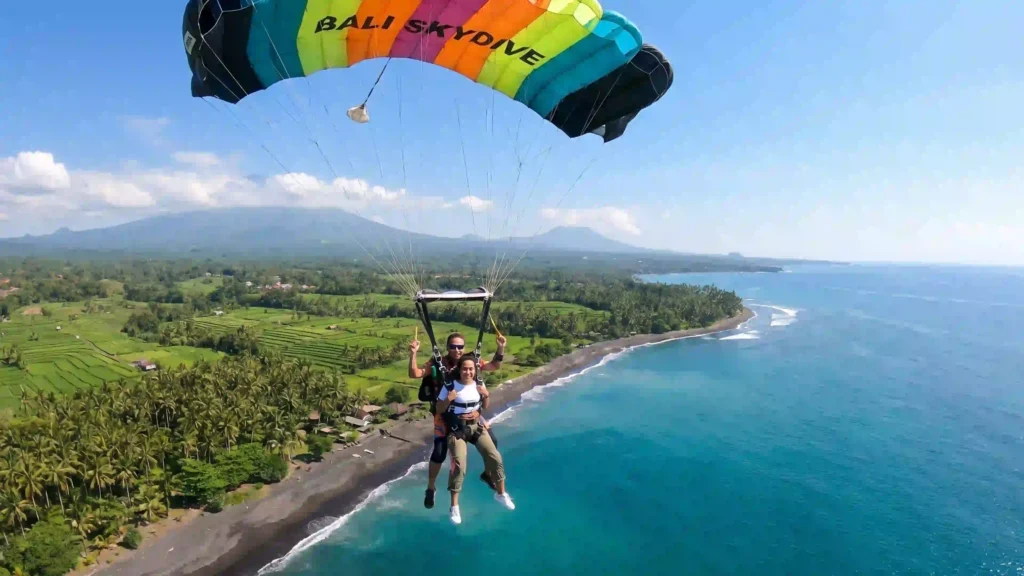
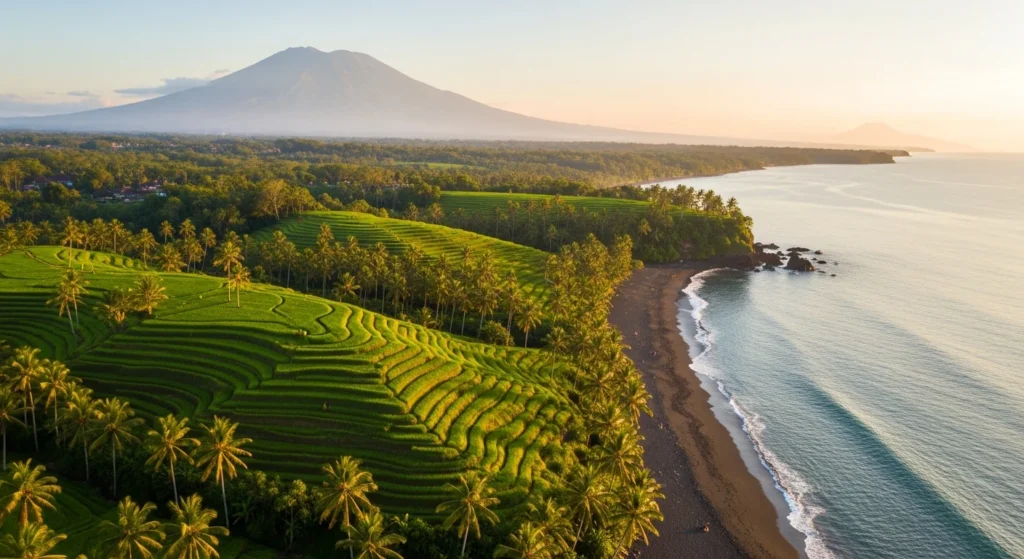
The final approach over Bali’s north coast is where the setting becomes part of the experience. As the canopy circles down toward the beach, the visual sequence typically includes:
The exact landing field, marked run-in, and ground crew setup are details Sky Dive Bali confirms once its Buleleng operation is live. The landscape described above reflects the drop-zone profile the operator has published for the route, not a guarantee of any specific field or flight path on a given day.
| Phase | What’s happening | Your role |
|---|---|---|
| Canopy opens | Freefall ends, glide begins, instructor checks the canopy | Relax, breathe, look around |
| Mid-canopy ride | Instructor steers toward the landing area, may offer you the toggles briefly | Enjoy the view, follow instructions |
| Final approach | Instructor lines up the run-in and reads the wind | Get into legs-up position on cue |
| Flare | Instructor pulls both toggles down to slow the descent | Hold legs up, look at the horizon |
| Touchdown | Instructor’s feet, and yours in a stand-up, contact the ground | Stay in position until told to stand |
| Unclipping | Harness connections are released | Wait for the instructor’s signal before moving |
| Do | Don’t |
|---|---|
| Keep your legs up until your instructor says otherwise | Reach your feet toward the ground early |
| Keep your hands on the harness straps unless told to hold the toggles | Grab the risers or lines without instruction |
| Look at the horizon, not straight down at your feet | Tuck your chin down and stare at the ground |
| Let your body go loose and follow the instructor’s movement | Tense up or try to land yourself |
| Wait for the unclip signal before standing up | Try to stand or walk before your instructor releases the harness |
A beach-route landing over Bali’s north coast is, mechanically, the same controlled sequence used at any tandem drop zone: canopy up, legs up, wind read, flare, touchdown, unclip. What changes is the backdrop. Sky Dive Bali’s tandem service over Buleleng is currently in a coming-soon stage; the operator has not opened bookings and has not confirmed a launch date, and the landing-field details above describe the published route profile rather than a day-of guarantee.
Sky Dive Bali’s published route runs over Buleleng’s black-sand coastline, and the landing sequence itself, the legs-up glide, flare, and slide-in or stand-up touchdown, works the same regardless of surface. The exact landing field and its surface are confirmed by the operator once bookings open, so treat any surface description before that point as a general route profile rather than a guarantee.
After roughly 60 seconds of freefall from the exit altitude, the parachute opens and the canopy ride becomes the slower half of the jump, long enough for your instructor to steer toward the landing area, point out coastal landmarks, and walk you through the legs-up position before the final approach begins.
Closed-toe athletic shoes with laces you can tighten are the standard recommendation for any tandem landing, coastal or otherwise, since loose sandals can slip off during the flare. Light, fitted clothing that won’t flap in the wind or snag on harness straps is the other common guidance instructors give before a beach-route jump.

Sky Dive in Bali Editorial Desk
Experience the thrill of skydiving in Bali with our certified instructors. Book your tandem jump today.